1133 Budapest, Tutaj u. 6/b, Cézár-Ház
 Opening hours: Mo-Fr 08:00-20:00
 Contact: +36 1 801 2250


Why does a painful tooth need root canal treatment?
Root canal treatment is typically carried out when tooth decay has destroyed the enamel and dentine, i.e. the hard tooth tissue, reached the pulp and caused inflammation there.
- While enamel and dentine consist largely of inorganic material without nerve pathways, the pulp contains blood vessels and the nerves that transmit pain to the brain. Tooth inflammation can therefore be accompanied by excruciating toothache that is hard to relieve.
So if decay is not stopped before the pulp becomes inflamed, relieving the pain and saving the tooth is only possible with root canal treatment.
What is the aim of root canal treatment?
- Removing the pus causing the inflammation, eliminating symptoms and saving the tooth.
- Preventing further complications and focal infections.
- Preventing reinfection by filling the root and sealing the canals hermetically.

3 reasons for root canal treatment
- You can avoid extraction and the need for a restoration or implant.
- The procedure, which many people simply know as having a nerve removed, is completely painless and is now as routine as an aesthetic filling.
- Our experienced and precise dentists have the most modern digital tools (3D CT, digital apex locator, dental microscope) and top-quality materials at their disposal.
Recommended for you
Book an appointment so we can relieve your symptoms as soon as possible!
Or book by phone:
What symptoms indicate that a tooth needs root canal treatment?
Symptoms of an inflamed tooth or infected pulp may include:
Pain:
- It occurs in response to cold, heat, biting, touch or tapping.
- It intensifies in response to the trigger, lingers and lasts longer and longer, eventually becoming severe toothache that does not respond even to painkillers.
- A dull pain or ache, but at night when lying down throbbing pain may also be felt.
Accompanying symptoms: facial swelling, fever, gum swelling or pus discharge near the infected tooth
Radiological signs: inflammation around the root tip, granuloma, cyst
When is it important to have root canal treatment?
• In the case of acute tooth inflammation, accompanied by severe pain.
• Because of pulp necrosis, which may be indicated by discolouration of the tooth, and can even be caused by a knock or injury to the tooth.
• In the case of chronic inflammation around the root tip of previously root-filled teeth, which can also trigger focal disease.
• If the pulp is exposed during a dental procedure. In this case, the tooth must be root-treated as a precaution because of the risk of later infection.
The risks of not having root canal treatment
- The infection can spread to neighbouring teeth.
- Once the pulp has died, the pain may stop, but the inflammation is still present and continues to spread.
- A fistula may develop, through which the accumulated pus drains into the mouth.
- Untreated infection attacks the jawbone, which can lead to further tooth loss and even facial deformity.
- An infected tooth and chronic inflammation are also responsible for the development of systemic diseases such as diabetes, respiratory problems, heart disease and circulatory complaints.
- With advanced inflammation, you may experience feeling unwell and chills. Fever and facial swelling are also signs that the infection is taking hold; at this stage the inflammation reaches the jaw and surrounding tissue layers, from where it can make the whole body ill. It can also cause osteomyelitis and skin disease.
Recommended for you
Book an appointment so we can relieve your symptoms as soon as possible!
Or book by phone:
Types of root canal treatment and how it is carried out
Today we distinguish two types of root canal treatment: conventional root canal treatment and microscopic root canal treatment.
Conventional root canal treatment can also be modern if it is carried out with digital technology and rotary instruments, making it an extremely precise and gentle procedure.
Thanks to the high magnification of microscopic root canal treatment, even the most complex cases can be treated and healed successfully.
- Your own tooth is the most “biocompatible implant”, so saving it is also in the patient’s best interest.
- Our modern digital tools make it possible for saving a tooth to be a success in the long term too.
- Treatment can give the tooth decades more life, so it is worth investing time and energy in saving it.
Recommended for you
Recommended for you!
- Microscopic root canal treatment – Why is it faster and more successful?
- What is the difference between conventional and microscopic treatment?
- What are the advantages of microscopic treatment, when is it recommended, and how does it work?
Conventional root canal treatment in 5 steps
1. Diagnosis:
• The dentist makes the diagnosis based on a panoramic X-ray, and also takes control X-rays at several stages of treatment. Thanks to our modern digital equipment, radiation exposure is so minimal that it can be used completely safely during procedures.
2. Opening the tooth:
• As the first step of completely painless root canal treatment, the dentist cleans the decay from the tooth, and after opening the pulp chamber, removes the infected pulp.
3. Root canal treatment:
• Using a purpose-designed machine, the dentist continues to open up the root canals. The infected tissue and debris are removed and the canals are thoroughly cleaned, creating ideal space for the later root filling.
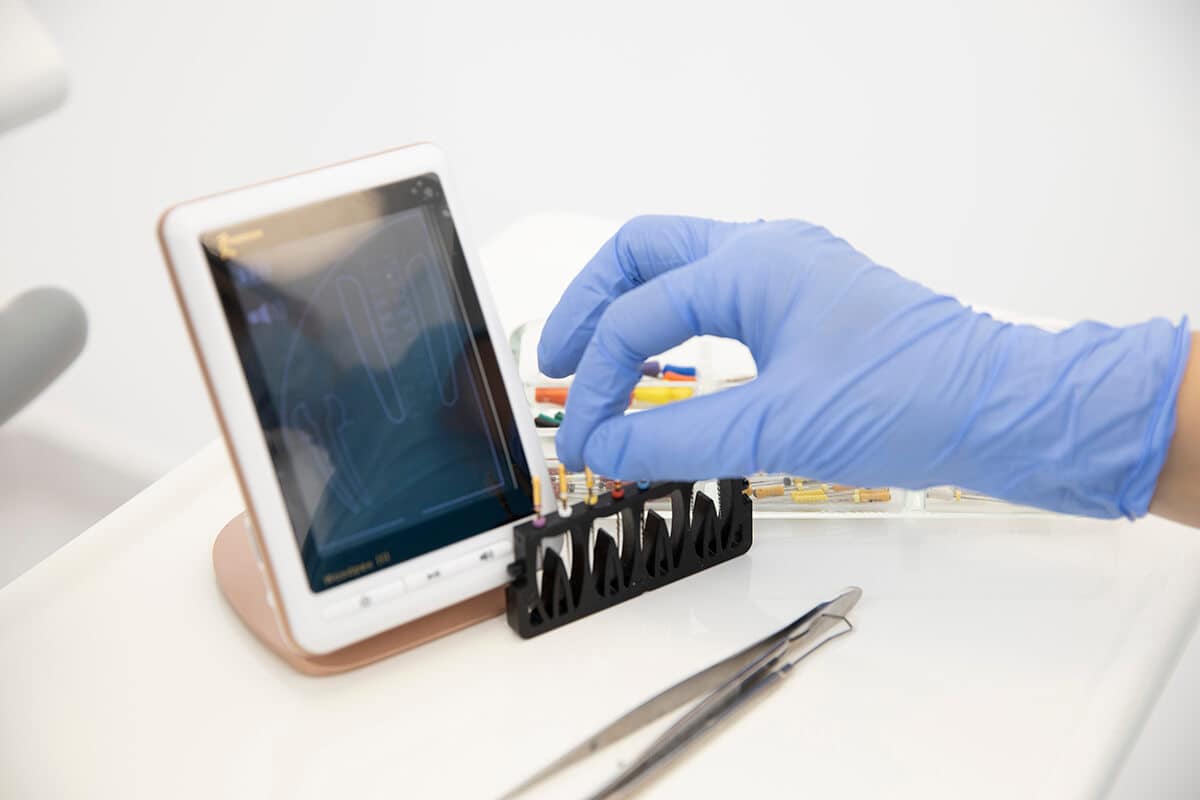
• During treatment, the length of the root canal is measured with a digital instrument, so that the root filling reaches exactly to the tip of the root.
• A control X-ray is taken of the final length of the canals.
4. Medicated root filling:
• Next, the root canal is filled with medication so that the tooth can continue to heal, and the tooth is then sealed with a temporary filling for about 7–10 days.
5. Final root filling:
• The dentist removes the temporary filling and the medication, which also kills any remaining pathogens, from the canals, and if the tooth is symptom-free, then permanently seals the root canals with a special filling material.
• A good final root filling reaches the tip of the root and fills the entire canal without gaps, so the tooth will not cause discomfort later and can no longer become reinfected.
What difficulties can arise during root canal treatment?
Root canal treatment is one of the procedures that requires the most precision, yet the result does not depend solely on the precision of the dental specialist.
Every tooth has different anatomical features and is in a different condition, and the body’s response to inflammation also varies, so root canal treatment has the least predictable outcome.
Recommended for you
Common problems after root canal treatment
- What are the symptoms of medication sensitivity?
- How should you brush your teeth after treatment?
- How can root canal treatment be avoided?
- What symptoms indicate focal disease?
Circumstances that make root canal treatment more difficult:
- With heavily infected teeth, root canal treatment and cleaning typically has to be carried out over several visits. The final treatment of such teeth, i.e. the permanent filling, can only be done once the tooth is free of symptoms.
- During root canal treatment, root canal files may break, and perforation of the tooth or root or a false path may occur.
- Certain anatomical features, e.g. narrow or curved roots, canal branches or extra canals, can complicate the treatment process.
- When removing an old post, it may break inside the canal.
- Teeth undergoing root canal treatment break easily. If the temporary filling falls out, a new temporary filling must be placed as soon as possible to prevent the tooth from breaking and the extraction that would then be needed.
Recommended for you
Book an appointment so we can relieve your symptoms as soon as possible!
Or book by phone:
Symptoms, complications and oral care after root canal treatment
A feeling of pressure may occur for 1–2 days after a medicated root filling:
- This is normal and goes away with painkillers. However, if the pain is so severe that painkillers are hardly effective, the tooth needs to be cleaned again.
- In this case, fluid produced during the inflammation causes pressure-like pain inside the tooth. However, cleaning and disinfecting the canals will also make the symptoms go away.
To fight more severe inflammation, the dentist may prescribe antibiotics:
- During a course of antibiotics, following the instructions is extremely important for healing and saving the tooth, so the prescribed medication must be taken.
- If you are sensitive, allergic reactions may occur, which must be reported to the dentist immediately.
- Taking antibiotics also affects the digestive system, so taking probiotics is recommended, and women may also want to take steps to prevent intimate health complaints.
Caring for root-filled teeth
After root canal treatment, most people skip dental check-ups for years, even though this is when they become truly important. Although the dentist does everything possible during treatment and uses every available tool and method, it can still happen that bacteria remain and the tooth becomes a focus of infection, putting a strain on the body.
The expected lifespan of a root-filled tooth:
90–95 per cent of patients who have had conventional root canal treatment still have a healthy, well-functioning tooth decades after treatment. Of course, this requires the patient to maintain good oral hygiene and attend regular dental check-ups.
The root-filled tooth should be checked every six months with a control X-ray, and you should attend conventional scaling or Guided Biofilm Therapy. With the latter, carried out at least every 6 months, we can even prevent tartar from forming, and bacterial colonies that cause decay are unable to attach and multiply.
Root canal treatment in District 13 – Why is Clinident a good choice?
Root canal filling is one of the most frequently performed treatments at Clinident Dental Centre. As it is one of the last chances to save the tooth, it is extremely important that the treatment is carried out as precisely as possible!
- For diagnosis, we take a digital X-ray or 3D CT scan so that we can see the exact position of the root and the extent of the inflammation.
- The root canal length is determined with a digital instrument in line with European standards, so we can work with perfectly accurate values.
- At our clinic we use the most modern iPad-controlled root canal motor available today.
- Root canal treatment is carried out under magnification, making it much more precise and accurate.
- The treatment is quick and painless, and on average our clinic performs nearly a thousand successful root canal treatments a year.
- In addition to conventional root canal treatment, microscopic root canal treatment is also available at our dental clinic.
This page was reviewed by: Dr. Péter Czigler