1133 Budapest, Tutaj u. 6/b, Cézár-Ház
 Opening hours: Mo-Fr 08:00-20:00
 Contact: +36 1 801 2250

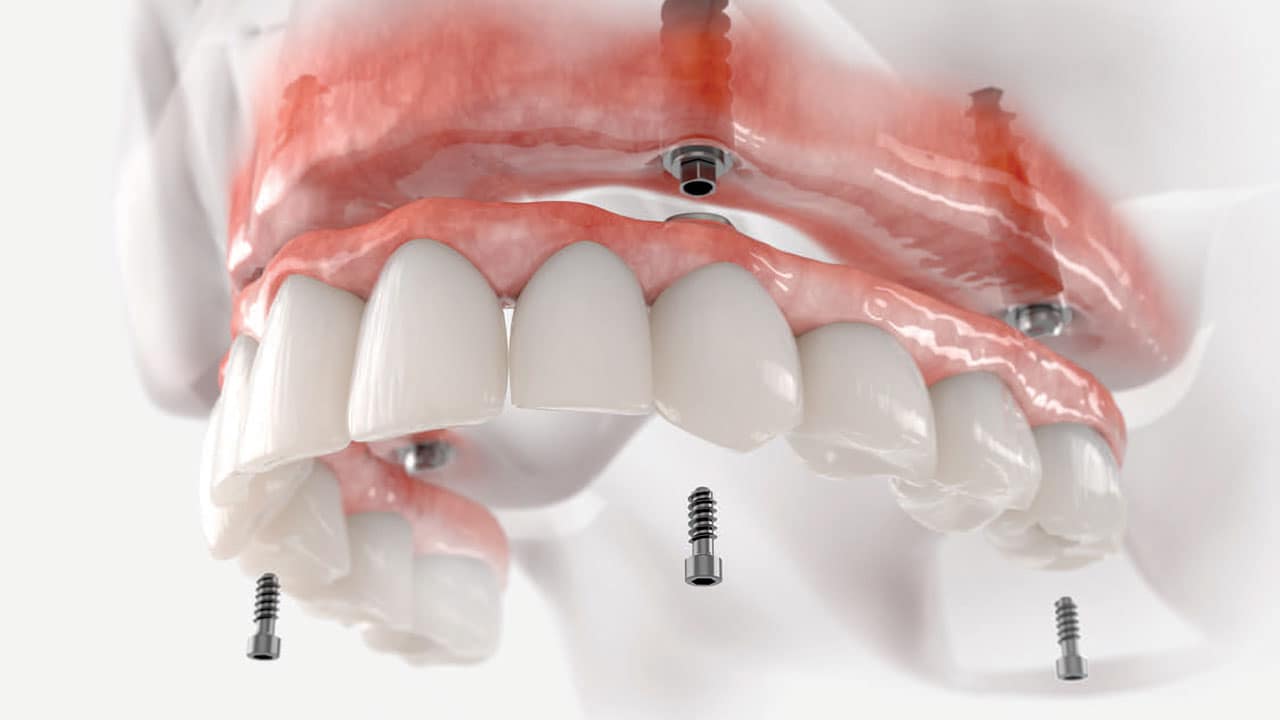
What can you expect if missing teeth are not replaced?
Missing teeth are not just an aesthetic problem for patients. It cannot be stressed enough that a restoration made in time really has a significant impact on quality of life.
What you really need to know about missing teeth:
- Not having enough teeth takes its toll on both nutrition and the efficiency of digestion.
- Where teeth are missing, the bone begins to break down. Neighbouring teeth tilt into the gap, drift and become loose.
- Without support, the face becomes sunken and the facial muscles sag, making you look decades older.
- Not only chewing but also speaking becomes difficult, and speech becomes less clear.
- A removable restoration, a traditional denture, lets you down in the most unexpected situations.
Tooth replacement options: types of dentures – which one is best, and when?
For complete or extensive tooth loss:
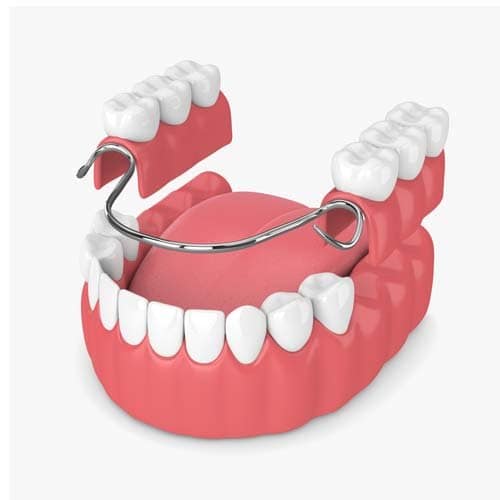
1. Partial removable denture: can be made to fit the remaining teeth when many teeth are missing. Examples include combined dentures and clasp-retained removable restorations.
2. Traditional removable denture: made for complete tooth loss. A special type is the telescopic restoration, which uses the last few (2–3) remaining teeth for stabilisation.
3. All-on-6: For complete tooth loss, a non-removable bridge prosthesis made on 6 implants. The special bridge prosthesis is fixed in place with screws and can only be removed by the dentist.
4. Palateless implant-supported denture: For complete tooth loss, a removable restoration can be made on implants. Types of fixed denture: bar-retained dentures and snap-on or locator-retained dentures.

Recommended for you
Combined restorations – Features and benefits. Who are they a good choice for?
- Types, features and alternatives of combined restorations
- The process, advantages and disadvantages of combined restorations
Partial removable denture
Although a dental bridge is an excellent solution for missing teeth, it is important to know that a bridge needs at least two supporting teeth. However, when back teeth are missing, i.e. with significant tooth loss at the end of the row, there are not enough abutment teeth to attach the bridge to. In such cases, a partial restoration is usually considered.
- The remaining teeth are used to hold the denture in place, and depending on the type of denture, porcelain crowns may also be made for them.
- The removable prosthesis consists of an acrylic or metal base plate and acrylic artificial teeth.
- The effectiveness of a partial denture, i.e. its stability, is achieved with special retention elements. A clasp-retained removable restoration is attached to the teeth next to the gap with metal clasps, while a combined denture is attached with hidden metal retention elements and precision attachments.
Traditional dentures
A full denture usually becomes necessary when the patient no longer has enough teeth to hold a partial denture in place.
A full removable prosthesis replaces all missing teeth in the lower or upper jaw, and a well-made denture creates a uniform smile and stops the patient’s face from looking sunken.
- The dental technician can make dentures similar in shape and colour to natural teeth and gums, so only a very small difference can be seen.
- The base of a removable prosthesis is called the plate, and it can be made of acrylic (plastic) or metal.
- The teeth are made of acrylic and fully reflect the characteristics of natural teeth.
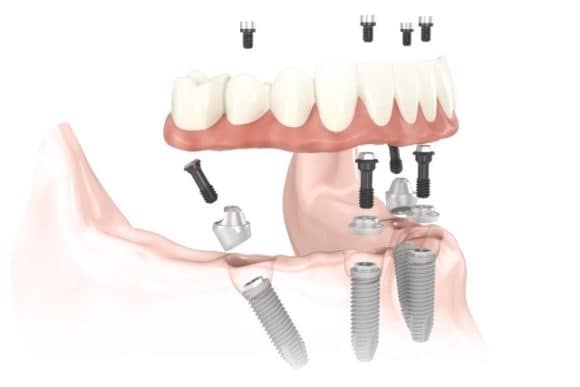
All-on-4 restoration – a custom bridge prosthesis for bone loss
If you want porcelain teeth that look like the originals for complete tooth loss, you need six implants in the lower jaw and eight in the upper jaw. A porcelain full-arch bridge can then be made on the implants.
One of the basic requirements for making a full-arch bridge and placing several implants is having a sufficient amount of bone, which is rarely the case with complete tooth loss, so bone grafting is usually also needed.

This is what an All-on-4 fixed restoration looks like
All-on-4 is a complex, specialised implant placement and restoration technology, specifically inspired by improving the quality of life of patients with bone loss who want a fixed, non-removable bridge prosthesis without bone grafting. Thanks to the All-on-4 and All-on-6 techniques, just 4–6 implants placed in the right positions may be enough to achieve the desired result.
- Thanks to the special implant placement technology, there is no need for more costly bone grafting.
- The finished bridge prosthesis connects to the implants with special implant prosthetic components, which also ensures that it is held extremely securely.
- According to Clinident’s specialists, placing 6 implants is preferable for a fixed bridge prosthesis that is most successful, durable and safely loadable in the long term.
Elegant palateless removable dentures and bar-retained implant-supported dentures
There are also implant types and retention components designed for bone loss, which not only stabilise removable dentures but also reduce the palate coverage to a minimum.
For patients looking for a less costly procedure, the removable denture is ultimately held in place not by denture adhesive and good luck, but by implants. So a bar-retained or snap-on denture means not only more comfort, but also a better quality of life.
Implant placement is the most modern choice for replacing missing teeth. The procedure is especially important for improving quality of life.
- An implant-supported denture looks completely natural.
- An implant-anchored denture can be used and loaded just like natural teeth.
- You can say goodbye to the sunken face caused by missing teeth, which makes you look younger.
- Denture adhesive is no longer needed at all, and a bar-retained denture can even be kept in overnight.
- The sore spots and sensitivity you experienced before will be a thing of the past, and cleaning is simple too, even without removing the denture.

How dentures and implant-retained dentures are made
After a consultation about implants or dentures – and drawing up a personalised treatment plan – you can have a full set of teeth within just a few days.
If you choose implants, after tooth extraction a temporary restoration, an immediate denture, is made. This means you won’t be without teeth while the implants heal and the final restoration is made.
After healing, following a few impressions and try-ins, the dental laboratory makes the new, stable denture on special retention elements attached to the implants.
Removable dentures and implant-retained dentures in 3 simple steps:
1. Impressions
2. Try-in
3. Fitting the finished full restoration

Recommended for you
Making dentures after tooth extraction – Case study – Clinident
- The treatment history with before and after photos
- Aesthetic dentures in Budapest
The most frequently asked questions from patients with complete tooth loss
How uncomfortable or painful is wearing dentures?
Life with dentures. A new, removable, traditional denture can be unpleasant and uncomfortable in the first few weeks, until you learn to live with it.
- The prosthesis may feel loose until the facial muscles and tongue learn to hold it in place.
- It is important to practise speaking aloud with it, forming words and pronouncing sounds.
- While getting used to wearing a denture, irritation or sensitivity of the gums and mucosa is often experienced.
- The amount of saliva may temporarily increase.
- Wearing dentures is very different from your own natural teeth. The learning process often requires patience, but once the mouth gets used to the denture, the complaints disappear.
Recommended for you
Fixed dentures – a smile that stays stable in the long term, for complete tooth loss
- What are the advantages of implant-retained dentures?
- Making fixed dentures in 7 steps
- Who do we recommend fixed dentures for?
5 typical problems solved by implant-retained dentures:
- No more need for denture adhesive.
- The denture does not fall out or move when speaking or eating.
- The palate section is reduced to a minimum and does not cause gagging.
- Easy to get used to, simple to handle and keep clean.
- It gives a natural-looking appearance, along with easy speech and pronunciation.
What can prevent a stable restoration?
Specialists recommend replacing teeth as soon as possible after they are lost, as this preserves more of the jawbone, which is one of the most important requirements for a stable restoration.
- If missing teeth are to be replaced with dental implants, the only problem that may stand in the way of surgery is a lack of sufficient bone.
- Whether a traditional denture stays properly in place also depends on factors such as the facial muscles, chewing pressure, gravity, the special design of the denture and the amount of bone.
- So bone loss is not only a problem for implants. Continuously shrinking bone also causes problems for denture wearers: the denture becomes unstable, and more and more repairs, known as relining, will be needed, as well as using lots of denture adhesive.
With an unstable denture and little bone, we have the following options:
1. Bone grafting surgery can create the conditions needed for 6–8 implants to integrate and bear load.
2. Without bone grafting, you can have a removable but extremely stable denture on fewer implants.
- The implants are placed in the part of the jawbone where a larger amount of bone is still available long after tooth loss.
- Denture adhesive is no longer needed, as the connection and stability between the implants and the denture are provided by special retention elements.

How are dentures cleaned, and can tartar form on dentures?
Even when wearing full dentures, impeccable oral hygiene is important. Every morning and evening, the gums, tongue and palate should be cleaned with a soft-bristled toothbrush. This removes plaque and stimulates blood circulation.
Cleaning traditional dentures in 4 steps:
1. Prevent the denture from falling and breaking: clean it over a bowl of water or a towel.
2. Before soaking with tablets, scrub the denture and remove food debris.
3. Using effervescent denture cleaning tablets helps prevent the denture from being stained by food and gives a fresher feeling.
4. Tartar can form even on dentures, so regular dental check-ups will still be needed, despite thorough denture care at home.
Oral hygiene when wearing partial dentures
It is extremely important for partial denture wearers to brush their remaining teeth thoroughly twice a day, to prevent tooth decay, gum inflammation and gum disease, which cause the loss of more natural teeth.
Caring for implant-retained dentures
An implant-supported full-arch bridge or bar-retained prosthesis will only be a lasting solution in the long term if you follow the guarantee conditions:
1. Continue to pay attention to oral hygiene at home.
Brush for 2 minutes twice a day and use the tools recommended by the dental hygienist.
2. You must continue to attend regular dental check-ups.
The dentist checks the condition of the implants on an X-ray, as poor oral hygiene can put not only teeth, but also implants at risk.
3. You must attend regular scaling.
Tartar can build up on the retention elements of the restoration, the denture and the implants just as it does on natural teeth.
To preserve implants for life, it is important to have regular check-ups with the dentist and also attend conventional scaling or Guided Biofilm Therapy. With the latter, the dental hygienist cleans plaque from the restoration and the area around the implants with the most modern tools, which are also the gentlest and safest for implants.

Denture prices – How much does a full denture cost?
For a full removable denture, a preliminary calculation is the simplest, but if you still have some of your own teeth, or want to attach the denture to implants, it is important to attend a consultation. An accurate, personalised quote can only be put together during an assessment.
Factors affecting the price of new dentures:
- Do you want to treat complete toothlessness, or is the problem only partial?
- Do you still have teeth that can be saved and incorporated into the new restoration?
- Do you want a removable denture or one attached to dental implants?
- Is there enough bone for implant placement, or is bone grafting also needed?
- Which implant system will you choose?
Full denture and partial prosthesis prices are available by clicking here, or in the price list menu.