1133 Budapest, Tutaj u. 6/b, Cézár-Ház
 Opening hours: Mo-Fr 08:00-20:00
 Contact: +36 1 801 2250


How does a dental bridge work?
A dental bridge is a restoration that spans the gap left by missing teeth; it is made as a single piece and attached to the abutment teeth or implants on either side.
Types:
- Bridge on your own teeth: The abutments supporting the bridge are the neighbouring teeth, which are ground down.
- Implant-supported bridge: Several missing teeth can also be replaced with a bridge fixed on implants. This solution is especially recommended for replacing the back molars, as when these are lost there are not enough abutment teeth to support a bridge from both sides, so without implants usually only a removable restoration could be made.
Parts of the bridge:
- Abutments: the porcelain crowns placed on the ground-down teeth or on the implants
- Pontic: the element connecting the abutments, i.e. the artificial teeth replacing the missing ones
A dental bridge can be made of:
- A metal framework with porcelain, also known as a porcelain-fused-to-metal restoration
- A metal-free zirconia bridge built on a zirconia ceramic framework
What it provides:
- It restores chewing function, the appearance of the teeth and speech.
- It looks natural, so it can even be used to correct the smile.
Recommended for you
Zirconia crowns offer a metal-free, aesthetic solution for restoring teeth and making dental bridges. They are elegant and look similar to natural teeth. Our detailed guide to the benefits and making of zirconia crowns explains when it is worth choosing this solution.
In this article:
Why is it important to replace teeth quickly?
Dental bridge or implant – which is the better choice?
When, and for whom, is a dental bridge the ideal solution?
Patient guide to getting a dental bridge
Why is it important to replace teeth quickly?
Even a single missing tooth can start a process that has a negative effect on all the teeth, and through them on our general physical and mental health.
A missing tooth immediately upsets the balance in the mouth, so the forces created when biting are not distributed evenly and the teeth become overloaded.
Complications of missing teeth
- Neighbouring teeth shift and loosen prematurely
- The balance of chewing is upset
- Bone loss develops, and damage to the periodontium may occur
- The risk of further tooth loss increases
- Deterioration of appearance and self-confidence
- In the long term, health problems may also develop
- If front teeth are missing, speech also becomes less clear
- Significant tooth loss can over time even contribute to dementia, as blood flow to the brain also begins to deteriorate in patients who are unable to chew.
Reasons to choose a dental bridge
- The negative consequences of missing teeth can be avoided
- More costly and complex treatments can be avoided
- A lack of confidence can be avoided
- The long-term health risks of missing teeth can be avoided
Dental bridge or implant – which is the better choice?
A dental bridge is a faster solution, while an implant is gentle on the neighbouring teeth. The choice depends on bone volume, time and the patient’s needs.
Advantages of a dental bridge
- Quick to make (in as little as 1–2 weeks)
- No need for surgery
- More cost-effective to start with
Advantages of an implant
- No need to grind down neighbouring teeth
- Helps prevent bone loss
- Provides a natural appearance
- Long lifespan, a long-term investment
When, and for whom, is a dental bridge the ideal solution?
Tooth replacement with a bridge – Recommended in the following cases:
- On your own teeth after extraction: this involves grinding down the teeth next to the gap.
- To close gaps that are too large: if you do not want to treat the aesthetic problem caused by congenitally missing teeth with orthodontic treatment.
- To stabilise loose teeth: by joining teeth that have become loose due to gum disease, we make use of the bridge’s splinting function, which reduces the mobility of the teeth.
A dental bridge is the ideal choice for those who:
- want a quick, predictable solution for missing teeth,
- would not undergo implant surgery,
- and whose neighbouring teeth need aesthetic or functional restoration anyway.
Types of restorations – Types of dental bridges
- Traditional dental bridge
- Implant-supported bridge
- Maryland bridge
- Cantilever dental bridge
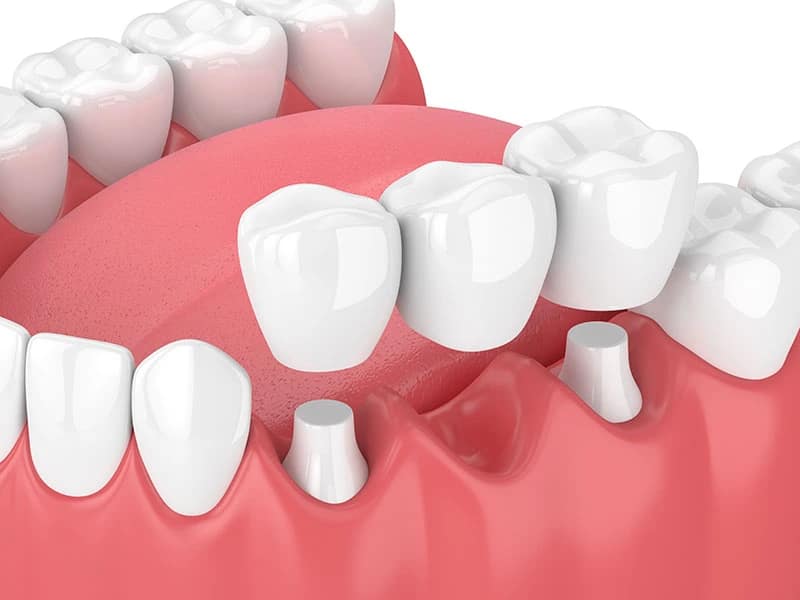
1. Traditional bridge
It replaces teeth effectively and is cost-effective and quick, which is why many people choose a traditional dental bridge.
- If a few adjacent teeth are missing, it is enough to grind down one neighbouring tooth on each side.
- With extensive tooth loss, more teeth will need to be ground down and additional supporting teeth included in the restoration.
2. Implant-supported bridge
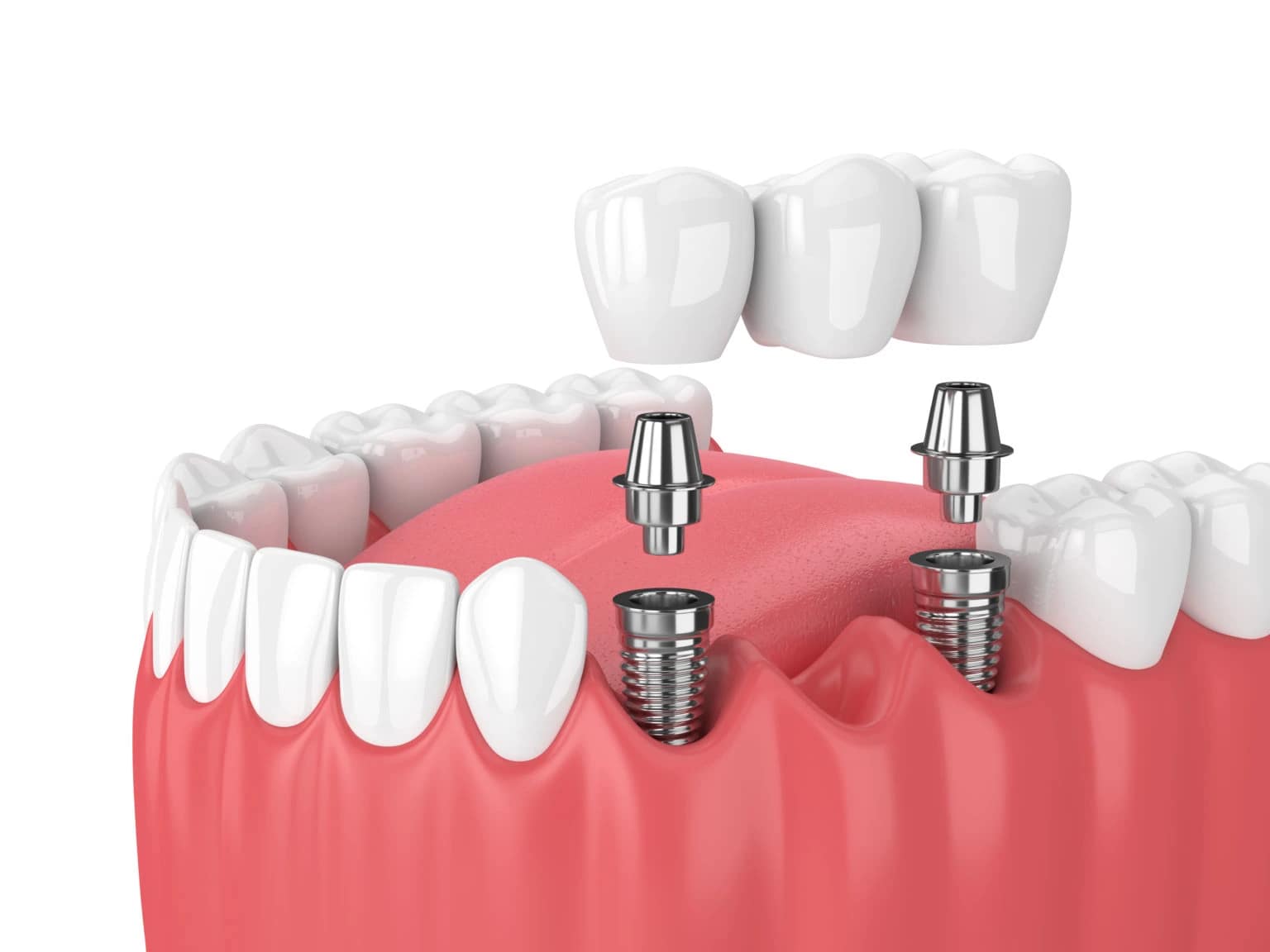
Dental implants are the most advanced solution for replacing lost teeth. When replacing several teeth with a bridge, the abutments of the bridge will be the implanted artificial roots.
Recommended for you
Dental implants offer a long-term, stable solution for replacing missing teeth. Our detailed guide to dental implants and the implant placement process explains when this solution is recommended and what you can expect during treatment.
- The implants are placed in the jawbone. After healing and osseointegration, a bridge is made on them.
- There is no need to grind down neighbouring teeth or for a removable restoration.
- It can even be used to replace all the teeth, avoiding removable dentures.
- An implant is a durable, natural-looking and tissue-friendly solution.
3. Maryland bridge
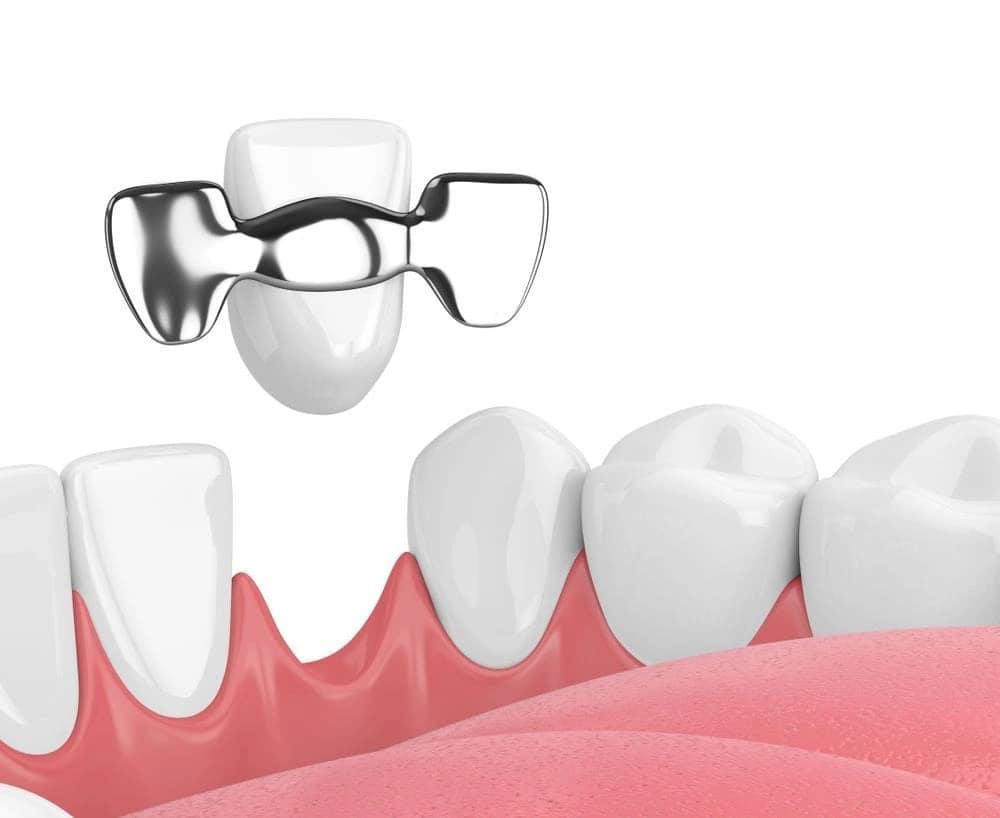
Neighbouring teeth do not need to be ground down, so it can replace lost teeth without any loss of tooth structure.
- Today this type of bridge serves as a kind of temporary, interim solution.
- The replacement tooth is made of reinforced ceramic and is attached to the inner surfaces of the neighbouring teeth with small “wings”, using strong dental adhesive.
- The “wings” remain invisible; only the porcelain can be seen from the outside, giving the impression of a natural tooth.
4. Cantilever dental bridge
Its key feature is that the artificial tooth replacing the missing one is supported on only one side of the bridge.
- We mainly use it to replace the very last tooth, if the teeth cannot be replaced with an implant or a denture.
- It can replace only a single tooth, and the result serves a mainly aesthetic function.
- It is mostly used for missing premolars and molars, when this is the only way to ensure that there are the same number of teeth opposite each other in the upper and lower jaws.
Recommended for you
Thanks to advances in the dental industry, the options for treating missing teeth have expanded significantly, and there is growing emphasis on personalised restorations. Planning a modern restoration is often a complex matter, in which the specialist has to consider several factors, so every case produces unique solutions and results.
How a dental bridge is made
A traditional dental bridge, which involves grinding down teeth, is made in several steps, but in a relatively short time – the final restoration is usually ready within 1–2 weeks.
1. Assessment and planning
Thanks to the manual examination, a panoramic X-ray and, where necessary, 3D CT scans, we get a comprehensive picture of the condition of the teeth, so a precise, personalised treatment plan can be drawn up.
2. Preparing the abutment teeth
Under local anaesthetic, we remove the damaged parts of the tooth and shape the base for the restoration by grinding.
3. Impressions and shade selection
Based on a conventional or digital impression, the zirconia or porcelain-fused-to-metal bridge is made in a dental laboratory.
4. Temporary restoration
Until the final bridge is ready, a temporary restoration is placed, which protects the prepared teeth and gums and provides an acceptable appearance until the final restoration is completed.
5. Fitting the final bridge
If the bridge fits properly and its colour and shape are perfect, the restoration is permanently fixed in place.
Patient guide to getting a dental bridge
How much pain is involved in making a restoration?
A traditional dental bridge involves grinding down your own teeth, so it is done painlessly under local anaesthetic. Making an implant-supported bridge involves no pain at all; local anaesthetic is only needed for the preceding implant surgery.
What can make creating a restoration difficult?
When preparing for a bridge, the treatment plan may need to be changed:
- A tooth may need root canal treatment: whether root canal treatment is needed also depends on how much tooth structure has to be removed during grinding for the abutment tooth to function properly.
- Metal allergy must be taken into account: we always recommend metal-free crowns to patients first, as metal sensitivity can develop at any age.
When making a porcelain bridge with a metal framework, we recommend having an allergy test beforehand. If a metal allergy develops after the bridge has been cemented, it can no longer be modified; the bridge has to be remade from metal-free material, which means extra costs for the patient.
- Adjusting bite height: in complex dental restorations, raising the bite is often necessary, which takes several months. In such cases, long-term temporary restorations adjusted to the new bite height are made, allowing the jaw to get used to the new relationships.
- Gum disease: with gum recession, the material the bridge is made of also matters. In many cases zirconia is more advantageous, as bacteria are less able to settle on its surface.
How many teeth can be replaced with a bridge?
With a traditional bridge, the main consideration is that there are abutment teeth on both sides to provide proper support and distribution of chewing forces. Generally, spanning a gap of 2–3 teeth can still be done comfortably. For larger gaps, a completely individual expert examination and plan is needed.
How many teeth are needed for a full-arch bridge?
A full-arch bridge means that a continuous bridge of about 12–14 teeth is made across an entire jaw to span several missing teeth. How many of your own teeth are needed for a full-arch bridge – i.e. whether one can be made on your remaining teeth – depends mainly on how many teeth need to be replaced and where the gaps are.
Planning is a complex task, and a poorly made bridge can have unpleasant consequences. Even your existing teeth may be put at risk because of unfavourable loading.
How should a dental bridge be cared for?
- Brushing twice a day, using interdental brushes and floss.
- Following the dentist’s instructions.
- Regular check-ups and professional cleaning after the restoration is completed.
- A healthy lifestyle
Dental bridge prices and guarantee Clinident, Budapest, District 13
What guarantees quality restorations at Clinident?
- Experienced specialists: Our dentists use the latest tools, techniques and materials when making restorations.
- Digital diagnostics: The most modern panoramic X-ray and 3D CT are available on site at our clinic.
- Advanced technology: For restoring teeth, smile design, microscopic root canal treatment, digital impressions and Guided Biofilm Therapy are available.
- A holistic approach to patient care: Our dentists always keep the long-term interests and health of the teeth in mind, while striving to achieve the most natural look possible with restorations.
- Modern dental laboratory: Every year our partner makes thousands of exceptionally unique and natural restorations using excellent, high-quality materials.
- Professional oral hygiene service: Between check-ups, our dental clinic protects the health of your teeth and the lasting shine of your restoration with EMS Guided Biofilm Therapy, the gentlest oral hygiene cleaning.
Dental bridge prices
To replace a single missing tooth (when the neighbouring teeth are healthy), the dentist recommends an implant instead. The procedure is quick and modern, there is no need to grind down your own teeth, and the restoration made on the implant is extremely durable, so it is an investment that pays for itself many times over.
Making a dental bridge is a complex process in which several factors must be considered, so only an assessment and a personalised treatment plan can give more detailed information about the expected costs.
You can find accurate information about restoration prices in the dental price list menu.
Dental bridge guarantee
Clinident Dental Clinic provides a guarantee on completed restorations for both porcelain-fused-to-metal and metal-free dental bridges. In return, the clinic’s patients receive personalised dental care: we provide regular dental check-ups and the opportunity to have the most advanced Guided Biofilm Therapy cleaning, which can even prevent tartar from forming.
What you need to do to keep the guarantee:
- After the final fitting, you must attend the FREE ADJUSTMENT appointment to check the bite height.
- You must attend the FREE annual check-ups.
- Once every six months, you must attend conventional SCALING or Guided Biofilm Therapy cleaning.
- In addition to professional cleaning, PROPER HOME CARE of your teeth is also essential, and our dental hygienists will help you establish it.
- If the dentist has given you a NIGHT GUARD, it must always be worn.
This page was reviewed by: Dr. Péter Czigler
Related restoration topics:
Recommended for you
Our case study of full mouth rehabilitation with zirconia restorations uses before and after photos to show how the bite and a harmonious smile can be restored at the same time.
Recommended for you
Our expert article Replacing back teeth – 11 reasons for dental implants explains why losing back teeth and replacing missing teeth causes difficulties.
Recommended for you
Our expert article on the symptoms of metal allergy and metal-free restoration options summarises who may develop a metal allergy, whether 100% metal-free restorations exist, and how symptoms can be eliminated.