1133 Budapest, Tutaj u. 6/b, Cézár-Ház
 Opening hours: Mo-Fr 08:00-20:00
 Contact: +36 1 801 2250

Paediatric dentistry is the field of dentistry that deals with children’s dental care from infancy and teething right up to the end of adolescence and the teenage years after the change of teeth. Paediatric dental care is not the same as adult dentistry; it requires specialist knowledge and communication skills.
The main areas of paediatric dentistry:
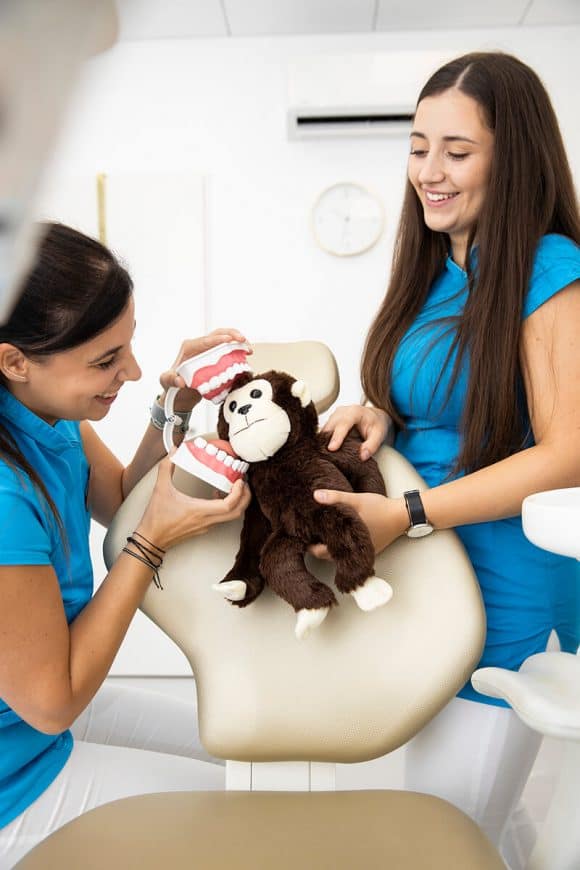
- Getting used to treatment: During relaxed, informal time, the dentist focuses on easing tension and building trust.
- Prevention: fissure sealing, fluoride treatment, oral hygiene care and dental care advice
- Treatment of baby teeth: fillings, extractions, root canal treatments
- Treatment of permanent teeth: treating early decay, developmental abnormalities, etc.
- Orthodontics: space maintainers, trainers, removable and fixed braces
- Treatment of injured teeth: care for accidents involving baby teeth and dental injuries
5 children’s dental problems that need a dentist
- If a baby tooth is injured or knocked in an accident:
A serious knock to a baby tooth may also affect the buds of the permanent teeth. After an accident, it is important for a paediatric dentist to see and treat the teeth.
- If the gum around a baby tooth is swollen, red or sensitive:
Careless brushing or an injury caused by the toothbrush can cause these symptoms. In more serious cases, however, trapped food can cause pus-filled gums in children too. It is worth showing it to a dentist.
- If yellowish-brown discolouration appears at the necks of the teeth:
Discolouration on the teeth can have various causes, so it is always worth seeing a dentist to rule out decay and remove tartar that causes inflammation.
- If baby teeth do not close properly because of dummy use:
Using a dummy, thumb sucking or other bad habits affect not only the development of baby teeth, but also the future of the permanent teeth. However, with effective tools, bad habits can be broken and baby teeth can be treated.
- If there is a black baby tooth in the mouth:
Teeth do not deteriorate suddenly, so if we don’t check brushing regularly, we may be faced with a greyed, decayed tooth, whose treatment cannot be delayed and is extremely important.

Why are children’s dental check-ups important, and what can happen without them?
A beautiful, healthy smile in adulthood is also thanks to care in childhood!
Why is paediatric dental care especially important?
- It helps prevent more serious, more painful problems: Without treatment, a bad baby tooth can endanger the health, or even the presence, of the permanent teeth.
- It helps avoid bad dental experiences: A dental problem detected early can be treated with less effort, even without the child noticing, while a neglected decayed tooth causes the child serious pain and an unpleasant experience.
- It contributes to children’s healthy physical and emotional development: Alongside healthy teeth, it supports wellbeing and self-confidence, so healthy teeth also help our child grow into a balanced, confident adult.
Recommended for you
Dental screening for expectant mothers – which symptoms make it necessary?
- What does family planning have to do with oral hygiene, and why is dental screening important in the first trimester?
- What can happen without dental screening after the second trimester?
- 5 important oral hygiene tips for expectant mothers
What can happen without children’s dental check-ups and treatment?
Because of bad habits, improper brushing and neglecting dental check-ups, many people undergo serious dental treatment even as teenagers: unpleasant drilling, root canal treatment and fillings, and often even tooth extraction may become necessary.
As parents, we want our children not to be shocked or paralysed by fear of the dentist, and for this it is important to know that:
- We don’t inherit bad teeth from our parents – only bad oral hygiene habits!
- There are no straight adult teeth free of gum inflammation without proper oral care and regular scaling.
- With proper dental care, regular dental check-ups and orthodontic treatment, dental problems after the change of teeth in childhood can be prevented, and with them early tooth loss and major dental problems in adulthood can be avoided.
The 7 most important dental treatments in childhood
It is important to mention that at our children’s dentistry clinic we avoid treatment at all costs!
For younger or anxious children, we recommend first booking an appointment to get used to treatment:
- As well as letting the child get used to the dental environment at their own pace, they can also try out the instruments.
- As part of the painless examination – and depending on how brave the child is – we may even take a panoramic X-ray, which gives the dentist an idea of the position of the teeth.
- We talk about preventable dental problems and proper oral care at home, and which toothbrush and toothpaste to use.
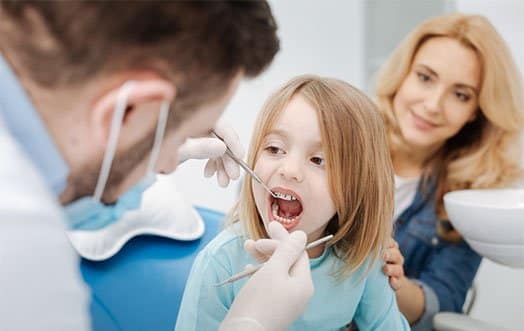
Types of paediatric dental treatment
1. Scaling, even for baby teeth
The scaling process is similar to that for adults, and it is indeed often necessary even for little ones. Later, during orthodontic treatment for children, cleaning and polishing the teeth becomes especially important, as it is important that teeth do not decay under fixed braces.
2. Fissure sealing to protect permanent teeth
One of the most important tools of prevention. Paediatric dentists recommend it for molars that are very difficult to clean thoroughly because of their deep grooves.
By filling the deep grooves with fissure sealing, we get a shallower chewing surface that is easy to clean, which can prevent or stop early decay.
3. Fillings for baby teeth
Treating a decayed baby tooth is extremely important, and dentists use a filling material with a special composition for this.
Recommended for you
Paediatric dentistry in Budapest!
- How paediatric dental treatments work, from baby tooth fillings to extractions
- What to look out for after treatment of a baby tooth?
- Children’s dental treatments – which one, how does it work, and what to do afterwards?
4. Root canal treatment for baby teeth
Just as with adults, if decay is so extensive that the baby tooth does not settle down and continues to hurt or become inflamed, root canal treatment for the baby tooth, carried out according to a special protocol, is needed.
Eliminating the inflammation is important, as not only can the permanent tooth be damaged, but it also puts a strain on the immune system.
5. Extracting baby teeth
If help comes too late, or root canal treatment does not help, it is better to remove the tooth and then concentrate on maintaining good oral hygiene. Baby tooth extractions are also carried out as part of our paediatric dentistry service.
6. Space maintainer – after extraction
Baby teeth are also very important because they hold the space for the permanent teeth that follow. So if they are extracted early, it is worth replacing this function with a space maintainer, so that there are no problems when the new tooth erupts.
7. Orthodontics for children – when should we start?
Orthodontic treatment can be divided into several age groups, as a different type of treatment and different braces are needed for baby teeth, for mixed dentition, and for treating the permanent teeth of a teenager.
So at our clinic, our dentists can help not only with treating bite problems, crowding and protruding teeth, but also with breaking bad habits even at nursery age.
Recommended for you
Orthodontics for children!
- We’ve gathered it all! These are the cases where children need braces. Can we do anything about it? Can it be prevented? What you need to know about orthodontics for children
- Important steps by age group – when should orthodontic treatment start?
- Orthodontic treatment for children – when is the right time to start?
Children’s dental problems – Advice from a paediatric dentist for home
Unfortunately, parents tend to give in to children when it comes to skipping brushing before bed or having a few more sweets.
Yet you are not a bad parent if you put a stop to endless snacking, teach proper brushing and don’t give in when brushing is refused with a tantrum! Creating a healthy environment for children’s teeth is always the parents’ responsibility.
Advice from paediatric dentists for parents:
- Regularity: Visit the dentist from the appearance of the first teeth, and from nursery age paediatric dental check-ups should definitely become a regular habit.
- Dental care at home: Follow the personalised oral care habits recommended by the paediatric dentist, and help your child with them.
- Diet: Aim for a balanced and healthy diet for your child, and pay attention to adequate mineral intake too.
- Pain relief: If there is a problem, children can be given toothache medicine or painkillers, which can prevent more severe pain and inflammation. It is important to discuss the dosage with your GP or dentist, and to go for a dental examination even if the pain goes away in the meantime.
How can we help children develop good oral hygiene habits?
1. Don’t overdo it
- Never talk about unpleasant or painful dental experiences in front of children.
- Don’t bribe them with gifts before, during or after a dental examination. This only reinforces the idea that there really is something to be afraid of.
2. Prepare for dental check-ups in a relaxed way
- Treat it as something natural, whether it is time for your child’s check-up or your own dental assessment.
- Talk often about why healthy teeth are important.
- Never use the dentist to frighten your child if they misbehave.
3. Brush your teeth together
- Brushing together not only teaches little ones regularity, but also helps them learn the right movements.
4. Checking
- Children are not capable of certain precise hand movements until they are at primary school.
- Their brushing should therefore be checked until they are at least 7–8 years old!
- When you do this, correct their hand movements and brush their teeth again. This also reinforces how important thoroughness is.
5. A good example is “catching” too!
- If there is something to improve about the appearance of your own teeth as an adult, don’t be afraid to take the plunge!
- Replacing missing teeth with implants or zirconia crowns, or straightening misaligned teeth with orthodontic treatment for adults, produces very impressive results.
- A good example helps children commit to their own health.
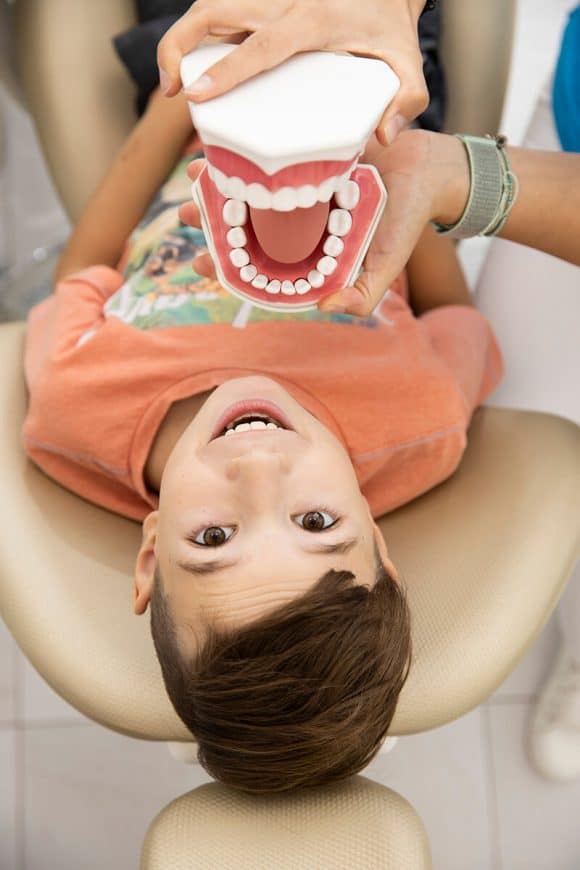
The most common myths about children’s teeth
Healthy baby teeth are vital if we want healthy permanent teeth. As young children we have twenty baby teeth in total, and their importance is much greater than it may seem at first.
Myth: Baby teeth are not as important as permanent teeth
It is extremely important that the health of the little teeth is maintained right up to the change of teeth! Poor oral hygiene can lead to the need for many dental treatments.
Keeping baby teeth healthy is always the parents’ responsibility:
- Baby teeth are what hold the space for the permanent teeth that erupt later.
- From the appearance of the first teeth (at about 6 months), it is necessary to clean the baby’s teeth regularly, as the sugar in breast milk is also an excellent breeding ground for decay.
- Playful brushing can start from as early as 18 months (when the baby molars appear), using a pea-sized amount of children’s toothpaste.
Myth: Fluoride is harmful in childhood
Baby teeth do need care, sometimes even with fluoride.
- If we leave fluoride treatment of the teeth to the dentist, it can very effectively help strengthen the teeth and build their resistance without harmful side effects.
Myth: Treating a decayed baby tooth is pointless, as it will fall out anyway
Young children also deserve more attention when it comes to dental treatment. Adults often don’t take warnings about decay in baby teeth seriously, even though keeping little teeth healthy is primarily the parent’s responsibility.
It is important to know that baby teeth are made of different material from permanent teeth. They are less resistant, and because of their weaker structure they decay easily and can quickly become inflamed.
- It is good to know that decayed baby teeth can hurt just as much as the permanent teeth that replace them. Furthermore, permanent teeth can only erupt healthily if the child’s mouth is free of harmful bacteria.
- Unfortunately, a decayed and neglected baby tooth infects the bud of the permanent tooth, which then needs treatment as soon as it erupts. So with a bad baby tooth it is extremely important not to put off seeing the dentist in the hope that it will fall out on its own.
Myth: Why take my child to the dentist unnecessarily if their tooth doesn’t hurt?
We expose our children to unpleasant experiences if, instead of prevention and getting to know the dentist, their very first dental experience is about pain and treatment.
- If we only go to the dentist when there is a problem, the dental visit is remembered as a bad experience.
- A bad experience fundamentally influences their attitude to dentistry as adults, just as it did for most of us adults.
Paediatric dentistry in District 13 – What does Clinident children’s dentistry offer?
Our clinic has experienced dentists with more than 10 years of paediatric dentistry experience and communication skills specialised for children. Our aim is for children to learn proper oral care in time, so that they don’t have to see the dentist more often than necessary.
Why choose Clinident’s paediatric dentistry specialists?
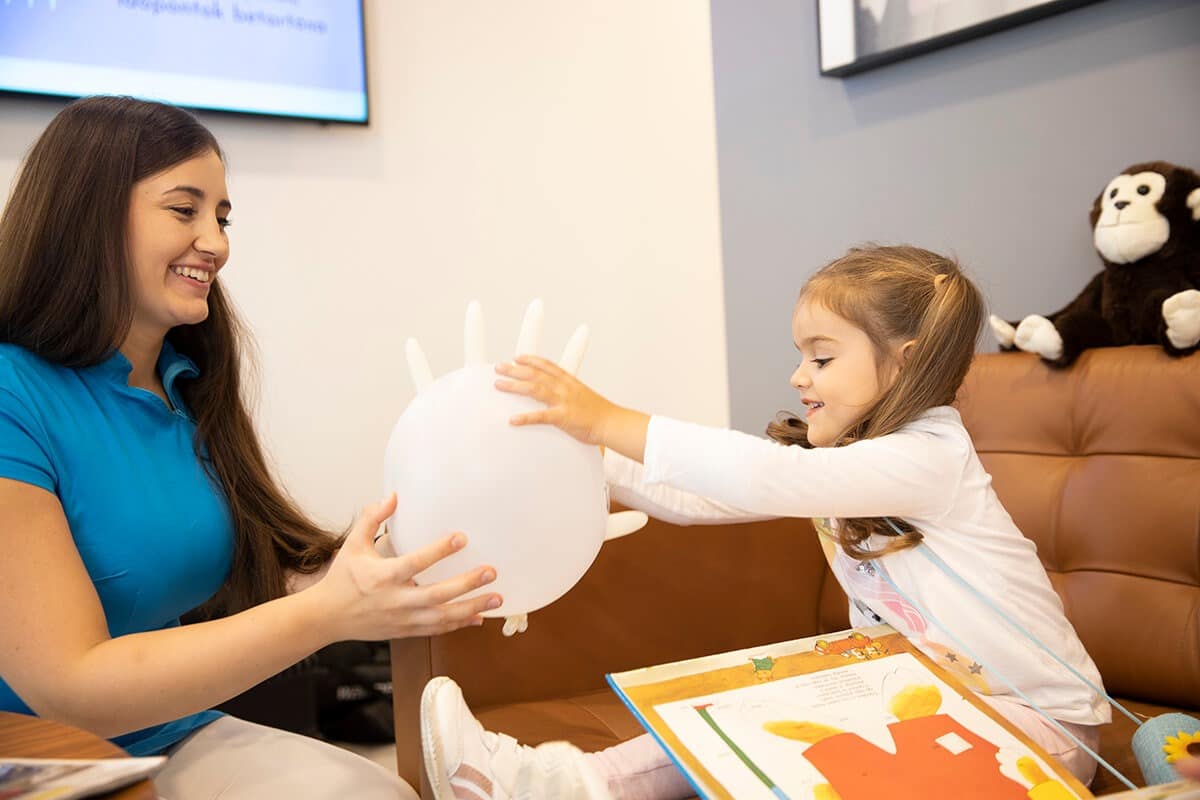
- During paediatric dental sessions, our surgery and waiting room are transformed into a child-friendly environment, with teddy bears and storybooks waiting for the little ones.
- Our children’s dentist is a favourite with children – charming and kind. With her, dental treatment is playful and painless.
- At our clinic, we have developed a prevention programme to prevent dental diseases in children, as prevention is always much, much better than treating a problem that has already developed.
- We help children enjoy going to the dentist, so that today’s children, as health-conscious adults, will attend dental check-ups without fear.